Lirc Serial Receiver Howtopriest
Lirc Serial Receiver Howtopriest Rating: 4,0/5 4142 votes
Vijeo Look - Download. Com provides 2. Results of keygen vijeo v6.0: Free download software, Free Video dowloads, Free Music downloads, Free Movie downloads, Games. UX/UI Designer; Software. BurnAware Premium keygen is a advance software to. Vijeo Designer 6.2.  Users can optionally include music. Some results look like psychedelic art from the 1970s. Schneider Electric Vijeo Designer v6.1.4 Sp4 Multilanguage (x86/x64). Telecharger Vijeo Schneider Look Meyegy. Vijeo Look V2.6 KeyGen: 11-Feb-2017: 2,216 KB/s: Vijeo Look V2.6 Download. If you search for. Can anyone give me a link to download keygen of Vijeo look v2.5 or v2.6, This is Schneider Electric hmi software just like Siemens Wincc. There is the link of vijeo look v 2.5 i will upload it in next few days,now all upload ok 7 * 49 231 872 + 40 067 041 part01.rar. Vijeo Look Keygen Music - vancouverloading. Vijeo Look 2.6 Full Download, Vijeo Look 2.6 Cracks, Vijeo Look 2.6. Electric Vijeo Designer 6.1.4 SP4 Vijeo Look 2.6 Crack, Vijeo Look 2.6.

Lirc Serial Receiver Howtopriest 3
Lirc Serial Receiver Howtopriest Number

Jlirc, a Java API for LIRC and WinLIRC. PC Remote Control (shareware) supports WinLIRC (and other receivers). IReX allows you to launch programs via remote control. Universal Infrared Control Engine (shareware) fully supports WinLIRC. IRAssistant (shareware) allows you to emulate mouse actions, launch applications, execute macros, and more.
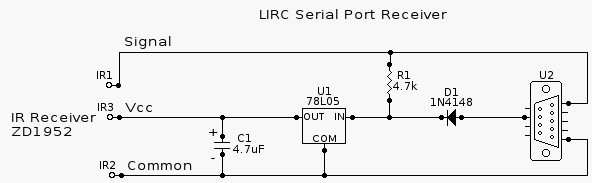
Here are the parts I used, all of them were cannibalized from old projects or scavenged from the engineering lab except the IR receiver that I ordered from Mouser.
Parts List:
Vishay TSOP1138 IR Receiver
50v 4.7uF capacitor
4001 Diode
4.7K resistor
7805 voltage regulator (5 volts)
Parts Discussion
TSOP1138 IR Receiver: Most people use the Vishay TSOP 1738, but Mouser was out of those when I ordered and the 1138 is comparable.. and it worked, so who cares : )
4.7uF capacitor: I used an axial 50v barrel (electrolytic) capacitor because I had one available and didn't want to spend 75 cents at Radio Shack. But, if you've got a 4.7uF ceramic disc capacitor, it would be a lot easier to fit inside the D-sub housing we're going to use. Also, since I used a 50v capacitor and we're only pushing 5v, it's going to have a pretty long rise time but it shouldn't affect the performance of our device too much.
7805 voltage regulator: I used a big one made by Motorola in the first one of these receivers I made and I had to clip the pins very short and clip and grind the top pole in order to get it to fit in the D-sub (see pictures of completed project). However, when I was digging around for pieces today, I came across a surface mount 7805 that I got from Texas Instruments as a sample years ago. It's tiny and perfect for this project. I'll definitely use it the next time I build one of these as it will cut the footprint of the circuit down tremendously. Both the large and small 7805's are labeled in the electronics closeup picture.
Sorry, I didn't realize I had 2 threads open on this, here's the reply I posted to the other thread. The threads should be joined I guess but I don't know how to do that yet.
I found that most of my issues came from following the installation instructions on lirc.org. I would like to volunteer to update those instructions, especially for users relatively new to Linux that don't know any better (like me!). My updates would need to be reviewed I think since I'm brand new to these forums. Here's what I would add for newbie's on lirc.org:
1) Please read through all the LIRC docmentation to familiarize yourself with the LIRC project and its history. When it is time to setup your Fedora 14 system please follow these updated instructions.
Updated LIRC instructions for users new to Linux.
Getting started with your home-brew serial IR receiver/transmitter:
First: Get lirc running manually:
1) Install Fedora 14, 2.6.35.6-45.fc14.i686 or later
Open a terminal
2) Manually free up the serial port your home-brew hardware will use, in this sample, COM1.
'sudo setserial /dev/ttyS0 uart none port 0 irq 0'
3) Manually load the lirc_dev.ko and lirc_serial.ko loadable kernel modules. First you need
to locate them using the find command:
'sudo find / -name lirc_*.ko'
On my system they were found here:
/lib/modules/2.6.35.6-45.fc14.i686/kernel/drivers/media/IR/lirc_dev.ko
/lib/modules/2.6.35.6-45.fc14.i686/kernel/drivers/staging/lirc/lirc_serial.ko
Load them using insmod, you must load lirc_dev.ko first:
'sudo insmod /lib/modules/2.6.35.6-45.fc14.i686/kernel/drivers/media/IR/lirc_dev.ko'
'sudo insmod /lib/modules/2.6.35.6-45.fc14.i686/kernel/drivers/staging/lirc/lirc_serial.ko'
After lirc_serial.ko is loaded you will see the device file /dev/lirc0 has been created. To allow
any user access to the lirc0 device change the permissions of the device file:
'sudo chmod 666 /dev/lirc0'
4) Install the usermode lirc software using the following command:
'sudo yum install lirc-*'
I'm sure you can do the same thing using the GUI Add/Remove Software tool but I didn't use it.
5) You may need to change permission on the files in /var/run/lirc:
6) Copy your LIRC config file to /etc/lirc/lircd.conf if you have one
7) Run the lircd daemon using its default settings: 'sudo lircd'
8)Run usermode lirc tools, mode2, irrecord, irsend
Second: To have LIRC startup at system boot time:
(Still on Fedora 14 2.6.35.6-45)
1) Use the 'Services' tool to Enable & Start LIRCD at system startup.
2) Add the following lines to your /etc/rc.d/rc.local startup script
# Stop the COM1 module and load the lirc_serial modules
setserial /dev/ttyS0 uart none port 0 irq 0
insmod /lib/modules/2.6.35.6-45.fc14.i686/kernel/drivers/media/IR/lirc_dev.ko
insmod /lib/modules/2.6.35.6-45.fc14.i686/kernel/drivers/staging/lirc/lirc_serial.ko
Note: There are probably smarter ways to disable COMn support
Ubuntu 10.04 LTS setup is similar but not exactly the same.
A notable difference on my Ubuntu setup was that the lirc tools use /dev/lirc by default so you must specify '-d /dev/lircd' for the tools to find the socket and '-d /dev/lirc0' for the tools to find the hardware serial port. Example: irsend needs /dev/lircd while irrecord needs /dev/lirc0, very confusing. I need to confirm this.
I found that most of my issues came from following the installation instructions on lirc.org. I would like to volunteer to update those instructions, especially for users relatively new to Linux that don't know any better (like me!). My updates would need to be reviewed I think since I'm brand new to these forums. Here's what I would add for newbie's on lirc.org:
1) Please read through all the LIRC docmentation to familiarize yourself with the LIRC project and its history. When it is time to setup your Fedora 14 system please follow these updated instructions.
Updated LIRC instructions for users new to Linux.
Getting started with your home-brew serial IR receiver/transmitter:
First: Get lirc running manually:
1) Install Fedora 14, 2.6.35.6-45.fc14.i686 or later
Open a terminal
2) Manually free up the serial port your home-brew hardware will use, in this sample, COM1.
'sudo setserial /dev/ttyS0 uart none port 0 irq 0'
3) Manually load the lirc_dev.ko and lirc_serial.ko loadable kernel modules. First you need
to locate them using the find command:
'sudo find / -name lirc_*.ko'
On my system they were found here:
/lib/modules/2.6.35.6-45.fc14.i686/kernel/drivers/media/IR/lirc_dev.ko
/lib/modules/2.6.35.6-45.fc14.i686/kernel/drivers/staging/lirc/lirc_serial.ko
Load them using insmod, you must load lirc_dev.ko first:
'sudo insmod /lib/modules/2.6.35.6-45.fc14.i686/kernel/drivers/media/IR/lirc_dev.ko'
'sudo insmod /lib/modules/2.6.35.6-45.fc14.i686/kernel/drivers/staging/lirc/lirc_serial.ko'
After lirc_serial.ko is loaded you will see the device file /dev/lirc0 has been created. To allow
any user access to the lirc0 device change the permissions of the device file:
'sudo chmod 666 /dev/lirc0'
4) Install the usermode lirc software using the following command:
'sudo yum install lirc-*'
I'm sure you can do the same thing using the GUI Add/Remove Software tool but I didn't use it.
5) You may need to change permission on the files in /var/run/lirc:
6) Copy your LIRC config file to /etc/lirc/lircd.conf if you have one
7) Run the lircd daemon using its default settings: 'sudo lircd'
8)Run usermode lirc tools, mode2, irrecord, irsend
Second: To have LIRC startup at system boot time:
(Still on Fedora 14 2.6.35.6-45)
1) Use the 'Services' tool to Enable & Start LIRCD at system startup.
2) Add the following lines to your /etc/rc.d/rc.local startup script
# Stop the COM1 module and load the lirc_serial modules
setserial /dev/ttyS0 uart none port 0 irq 0
insmod /lib/modules/2.6.35.6-45.fc14.i686/kernel/drivers/media/IR/lirc_dev.ko
insmod /lib/modules/2.6.35.6-45.fc14.i686/kernel/drivers/staging/lirc/lirc_serial.ko
Note: There are probably smarter ways to disable COMn support
Ubuntu 10.04 LTS setup is similar but not exactly the same.
A notable difference on my Ubuntu setup was that the lirc tools use /dev/lirc by default so you must specify '-d /dev/lircd' for the tools to find the socket and '-d /dev/lirc0' for the tools to find the hardware serial port. Example: irsend needs /dev/lircd while irrecord needs /dev/lirc0, very confusing. I need to confirm this.